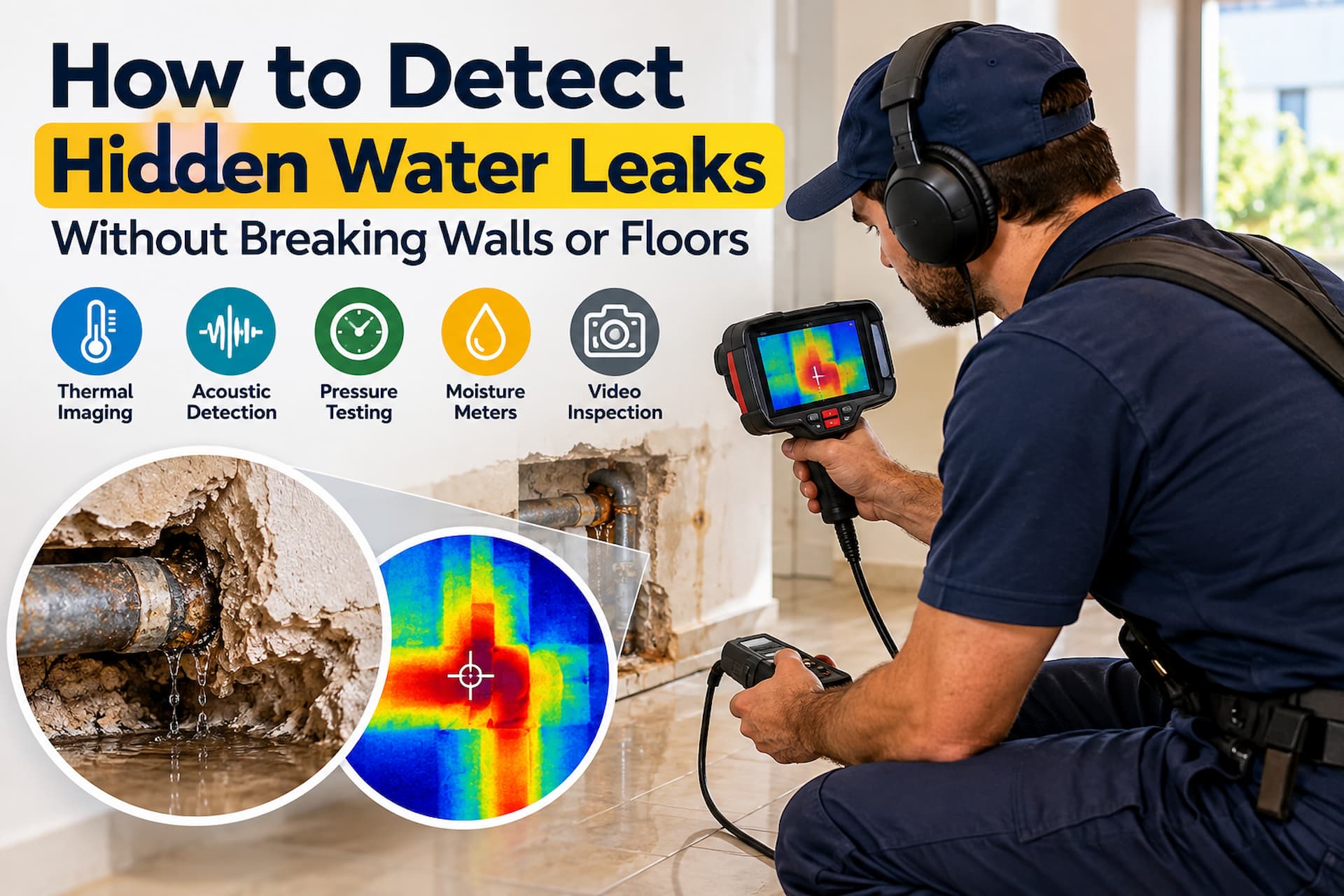
Without Breaking Walls or Floors
A hidden water leak can cause significant damage long before a homeowner sees water on the floor. Leaks may develop inside walls, beneath tile, under concrete slabs, around plumbing fixtures, or along concealed supply lines.
Traditionally, finding these leaks could involve opening walls or removing flooring until the damaged pipe was located. Modern leak detection has changed that approach.
Professional technicians can now combine thermal imaging, acoustic detection, pressure testing, moisture measurement, and video inspection to narrow down the source of a leak before invasive work begins.
Understanding how these methods work can help property owners make better decisions when unexplained moisture, high water bills, or recurring water damage appears.
Common Signs of a Hidden Water Leak
Hidden leaks do not always create an obvious puddle. In many cases, the first warning signs appear somewhere away from the actual damaged pipe.
Common indicators include:
- An unexplained increase in the water bill
- Damp or discolored walls
- Peeling or bubbling paint
- Mold or persistent musty odors
- Moisture appearing on a ceiling below a bathroom
- Warm areas on floors
- Water stains that return after repainting
- Loose flooring or damaged tiles
- Unexplained sounds of running water
- A water meter that continues moving when fixtures are closed
These symptoms can indicate a plumbing leak, but they do not necessarily identify its exact location.
For example, water entering a ceiling below a bathroom does not automatically mean that the pipe directly above the visible stain has failed. Water can travel along concrete, structural components, waterproofing layers, or pipe channels before becoming visible.
This is one reason accurate diagnosis is important before demolition begins.
Why Guessing the Location of a Leak Can Be Expensive
Opening a wall or removing tiles based only on the visible moisture can create unnecessary repair costs.
The location where water appears and the location where it originates may be several feet apart. In multi-story buildings, water may also migrate through floors and structural elements.
A systematic inspection attempts to answer two separate questions:
Is there an active leak?
And, if there is:
Where is the most likely source?
Professional testing can substantially reduce the search area before any destructive work is considered.
Thermal Imaging for Water Leak Detection
Thermal imaging cameras are commonly used during non-invasive building inspections.
A thermal camera does not literally see water inside a wall. Instead, it measures differences in surface temperature.
Moisture and leaking pipes can alter the temperature patterns of walls, ceilings, and floors. A trained technician can use these patterns to identify areas that deserve closer investigation.
Thermal imaging can be particularly useful when inspecting:
- Hot-water supply lines
- Bathrooms
- Ceilings below plumbing fixtures
- Concealed pipes
- Underfloor heating or plumbing systems
- Areas affected by persistent moisture
However, thermal imaging should not normally be treated as proof by itself. Temperature variations can also result from insulation, sunlight, HVAC systems, or building materials.
For this reason, experienced inspectors often confirm thermal findings using another testing method.
Acoustic Leak Detection
Pressurized water escaping through a damaged pipe can generate sound and vibration.
Specialized acoustic equipment amplifies these signals, allowing technicians to listen for patterns associated with leaking pipes.
This method can be particularly valuable when pipes are concealed beneath floors, inside walls, or below concrete.
Background noise, pipe material, water pressure, and the depth of the pipe can affect the results, so acoustic testing works best when combined with knowledge of the plumbing layout and other diagnostic information.
Plumbing Pressure Testing
Pressure testing can help determine whether a particular plumbing circuit is losing pressure.
A technician can isolate a section of the system and monitor its behavior under controlled conditions. A pressure drop may indicate that the isolated line requires further investigation.
This method is especially helpful because it can prevent technicians from investigating unrelated plumbing systems.
For example, if a property contains separate hot- and cold-water lines, testing can help determine which circuit should be examined more closely.
Moisture Meters
Moisture meters provide another useful layer of evidence.
These instruments can compare moisture levels at different points on walls, ceilings, or floors. By mapping the readings, an inspector can better understand how moisture has spread through the building material.
A moisture meter alone usually cannot identify the exact damaged fitting or pipe, but it can help distinguish between dry and affected areas and support findings from thermal or acoustic testing.
Video Camera Inspection for Drainage Problems
Not every water problem originates from a pressurized supply pipe.
Drainage systems can develop cracks, failed joints, blockages, or other defects. When the suspected problem involves a drain or sewer line, a small inspection camera may be inserted into accessible piping.
Video inspection can reveal conditions such as:
- Cracked drainpipes
- Damaged connections
- Pipe displacement
- Internal obstructions
- Deteriorated sections
- Foreign objects
- Certain joint failures
This allows the drainage system to be inspected internally without immediately opening floors or walls.
Water Supply Leak or Drain Leak?
Distinguishing between these two problems is important.
A pressurized supply-line leak may continue whenever the water system remains pressurized. A drainage leak, by contrast, may appear primarily when a sink, shower, bathtub, washing machine, or toilet is being used.
Technicians may reproduce specific operating conditions during an inspection to determine which activity causes moisture to appear.
This diagnostic process can prevent unnecessary repairs to perfectly functional supply pipes when the real problem is associated with drainage, waterproofing, or a plumbing fixture.
Sometimes the Pipe Is Not the Problem
One of the biggest mistakes in leak investigation is assuming that every moisture problem is caused by a broken pipe.
Water intrusion may also result from:
- Failed bathroom waterproofing
- Damaged roof waterproofing
- Deteriorated sealant
- Poor drainage
- Cracks in concrete
- Defective plumbing connections
- Rainwater penetration
- Condensation
- Improper slopes around wet areas
An accurate inspection therefore looks at the entire situation rather than searching only for a damaged pipe.
A Better Professional Leak Detection Process
A structured inspection generally begins with understanding the history of the problem.
When did the moisture first appear? Does it happen continuously or only when a particular fixture is used? Has the water bill increased? Have previous repairs already been attempted?
After gathering this information, technicians can visually inspect the affected area and select appropriate diagnostic tools.
The process may include thermal scanning, moisture mapping, acoustic testing, pressure testing, and drainage inspection.
When several independent findings point toward the same location, technicians can narrow the repair area considerably.
The objective is not necessarily to guarantee that no surface will ever need to be opened. If a concealed pipe requires repair, some access may ultimately be necessary.
The important difference is that detection occurs before demolition, allowing any required opening to be more targeted.
Why Accurate Detection Matters
Targeted leak detection can reduce unnecessary damage to finished properties.
Opening multiple areas while searching for a leak can mean replacing additional tiles, repainting walls, repairing ceilings, and extending project time.
Accurate diagnosis can also identify cases where plumbing repairs are not the appropriate solution at all.
For property owners, this makes professional leak detection an important diagnostic step before authorizing extensive demolition.
When Should You Call a Leak Detection Professional?
Professional inspection should be considered when:
- Water damage repeatedly returns after repairs
- The source of moisture cannot be seen
- A water bill suddenly increases without a clear reason
- A leak is suspected beneath finished flooring
- Multiple rooms show moisture simultaneously
- A downstairs ceiling becomes wet after upstairs plumbing is used
- Previous repairs have failed to solve the problem
- Significant demolition has been proposed without diagnostic testing
The more expensive the surrounding finishes are, the more valuable accurate diagnosis becomes.
Final Thoughts
Modern leak detection is not based on a single device. The most reliable investigations combine building knowledge with several diagnostic techniques.
Thermal imaging can identify unusual temperature patterns. Acoustic equipment can help locate the sound of escaping pressurized water. Pressure testing can isolate problematic plumbing circuits. Moisture meters can map affected building materials, while video inspection can reveal internal drainage defects.
Together, these techniques can help professionals locate hidden water leaks while minimizing unnecessary demolition.
For a practical example of professional water leak detection without unnecessary breaking or demolition, readers can learn more from wadyalnail Water Leak Detection, a specialist provider using modern diagnostic equipment to investigate concealed water leaks.